
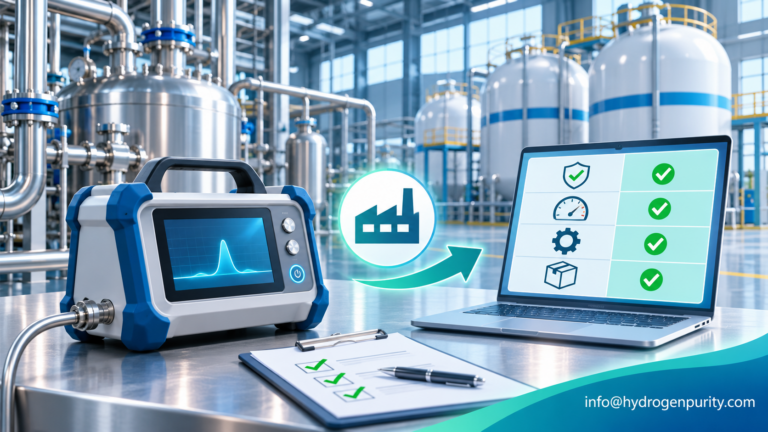
Hydrogen production plants need dependable gas monitoring to detect leaks early, support safe operations, and help protect personnel and equipment. A hydrogen gas monitor can provide continuous warning when hydrogen escapes from piping, compressors, electrolyzers, storage systems, or other process equipment. But a detector is only effective when it is suited to the hazard, installed in the right location, maintained correctly, and connected to an appropriate response plan.
This guide explains common monitoring challenges and practical steps for choosing and managing hydrogen gas detection in production facilities. Site-specific decisions should be verified by qualified process-safety and instrumentation professionals against applicable codes, permits, and local authority requirements.
Why Hydrogen Monitoring Requires Careful Planning
Hydrogen is colorless and odorless, so a leak cannot be identified by sight or smell. It has a wide flammable range in air and low ignition energy, making prompt detection and effective ignition control important. Hydrogen is also very light and disperses rapidly in many open settings. In enclosed or poorly ventilated spaces, however, it can collect near ceilings, roof pockets, equipment canopies, or other high points.
These properties create a practical challenge: there is no single detector position or alarm setting that works for every plant. A hydrogen gas monitoring system must reflect the process layout, ventilation, release scenarios, and the facility’s safety requirements.
Hydrogen detection is one layer of protection—not a substitute for sound process design, ventilation, leak prevention, hazardous-area controls, or emergency procedures.
Common Hydrogen Gas Monitoring Problems
1. Detectors are installed where they are easy to reach, not where leaks are likely
A hydrogen gas detector mounted for convenient access may be too far from a likely release point or outside the path a gas plume would take. Hydrogen movement depends on release pressure, temperature, equipment geometry, airflow, and enclosure design. Although hydrogen tends to rise in still air, ventilation and process conditions can redirect or dilute a leak.
What to do: Identify credible release points first, then assess likely gas movement. Use a documented hazard review and, where needed, ventilation analysis or gas-dispersion modelling to inform detector locations.
2. The sensor technology does not match the application
Different sensor technologies have different response characteristics, operating limits, environmental tolerances, and maintenance needs. A device suitable for one room or process may not perform reliably in another. Sensor selection also matters in atmospheres where oxygen may be limited or where contaminants could affect performance.
What to do: Compare detector specifications with the actual operating environment, including expected hydrogen concentration, temperature, humidity, pressure, contaminants, ventilation, and required response time. Confirm that the sensing principle is suitable for the application and that the manufacturer’s limitations are understood.
3. Alarm settings are copied from another site
Alarm thresholds affect operator response, but a value that is appropriate for one application may be unsuitable for another. Setting alarms too high can delay warning; setting them too low without understanding normal operating conditions may lead to nuisance alarms and reduced confidence in the system.
What to do: Establish alarm levels through the facility’s risk assessment and design basis. Document the rationale, required operator actions, and any automatic responses. Do not treat a generic setting as a substitute for site-specific engineering review or applicable regulatory requirements.
4. Calibration and functional testing are overlooked
A hydrogen gas detector that displays a normal reading may still have a failed sensor, blocked inlet, faulty wiring, or impaired alarm output. Calibration drift, environmental exposure, and aging can also affect performance.
What to do: Follow the detector manufacturer’s instructions and the plant’s approved maintenance programme. Keep records of calibration, functional tests, repairs, sensor replacement, and any out-of-service periods. Define compensating measures when monitoring is unavailable.
5. Alarms do not lead to a clear response
An alarm has limited safety value if personnel do not know what it means or what actions to take. Confusing alarm routing, unclear escalation steps, or untested shutdown interfaces can delay an effective response.
What to do: Assign clear responsibilities, define alarm actions, train relevant staff, and test the complete path from detector signal to annunciation and any approved control-system response.
How to Select a Hydrogen Gas Monitor
A hydrogen gas monitor for a production plant should be selected as part of a complete detection and response system. Review the following factors before specifying equipment.
Define the detection objective
Be clear about what the system is intended to detect and what action should follow. Objectives may include early warning of a leak, monitoring a defined enclosure, initiating an operator alarm, or supporting a safety-instrumented function. These purposes can involve different design, reliability, and verification requirements.
Review the operating environment
Check the manufacturer’s published specifications for:
- Hydrogen measurement range and response characteristics
- Operating temperature and humidity limits
- Resistance to expected contaminants and environmental exposure
- Enclosure protection and installation requirements
- Power, signal, communications, and diagnostic features
- Hazardous-area suitability where required
- Calibration method, interval guidance, and serviceability
Do not assume that a detector’s general industrial rating makes it appropriate for every classified area or process condition. Confirm certification and installation requirements for the facility’s jurisdiction and hazardous-area classification.
Consider the full system, not just the sensor
A hydrogen leak detection system for production plants may include fixed detectors, local or control-room indicators, alarms, control-system interfaces, power supplies, communications, and maintenance procedures. Verify compatibility between components and define what happens if a detector, cable, network, or power supply fails.
For safety-related functions, the required architecture, independence, proof testing, and documentation should be established through the relevant process-safety lifecycle and applicable standards.
Hydrogen Detector Placement in Industrial Facilities
Detector placement should be based on credible leak scenarios and the expected movement of hydrogen—not on a universal spacing rule.
Start with release points
Review equipment and connections that could release hydrogen, such as:
- Electrolyzer equipment and associated gas handling
- Compressors, pumps, valves, flanges, and seals
- Pressure regulators and sampling points
- Purge, vent, and drain arrangements
- Storage and transfer connections
- Enclosed skids, cabinets, or equipment rooms
Prioritise locations according to the likelihood and consequences of a release, rather than distributing detectors evenly without a supporting analysis.
Assess airflow and geometry
Map supply and exhaust ventilation, obstructions, ceilings, roof structures, enclosed spaces, and potential stagnant zones. A detector positioned high may be appropriate where hydrogen can accumulate, but high placement alone does not guarantee effective coverage. Strong air movement may carry gas away from a ceiling detector, while beams or enclosed pockets may create local accumulation points.
For complex rooms or high-consequence applications, use a competent engineering assessment to confirm coverage. Account for normal ventilation and foreseeable ventilation failures where relevant to the design basis.
Provide access for inspection and maintenance
A hydrogen gas detector must remain accessible enough for inspection, calibration, testing, and replacement. Avoid positions where routine maintenance requires unsafe access or where equipment, dust, water, vibration, or accidental impact could impair the sensor.
Record each detector’s location, tag number, coverage objective, alarm routing, and maintenance requirements in controlled plant documentation.
Alarm Management and Operator Response
An effective system connects detection to a defined, rehearsed response. The response should be proportionate to the alarm level and consistent with the facility’s emergency and operating procedures.
A site procedure may specify actions such as:
- Acknowledging and communicating the alarm
- Avoiding ignition sources and following access restrictions
- Checking detector status from a safe location
- Following approved isolation or shutdown procedures
- Evacuating or restricting access where required
- Notifying the responsible control-room operator and emergency team
- Returning the area to service only after authorised assessment
Do not instruct untrained personnel to enter a suspected hydrogen release area to investigate. Alarm response, isolation, and re-entry criteria should be established by the facility’s competent safety and operations teams.
Calibration, Testing, and Maintenance
Routine maintenance helps confirm that the monitor remains capable of detecting hydrogen and communicating an alarm. A practical programme should include:
- Inspection: Check the detector, sensor inlet, enclosure, mounting, wiring, and environmental conditions for damage or obstruction.
- Functional testing: Confirm that the sensor responds to the approved test method and that alarms and outputs operate as intended.
- Calibration: Use the manufacturer-approved method, equipment, and test gas where specified. Record results and any adjustments.
- Fault management: Investigate recurring faults, drift, nuisance alarms, or failed tests. Replace or repair equipment in accordance with approved procedures.
- Documentation: Maintain traceable records of tests, calibration, repairs, changes, and temporary impairments.
- Competency: Ensure personnel performing work are trained for the detector model, test equipment, and facility procedures.
Calibration intervals should be determined from manufacturer guidance, operating experience, risk assessment, and applicable requirements. Environmental conditions and performance history may justify more frequent checks. Avoid extending intervals solely to reduce maintenance effort without a documented technical basis.
Standards, Compliance, and Engineering Review
Requirements for gas detection vary by country, industry, facility design, and the function of the detection system. Applicable rules may address hazardous-area equipment, electrical installation, occupational safety, fire and explosion protection, process safety, and functional safety. European and North American facilities may be subject to different frameworks, and local permits or authority requirements can add further obligations.
Before installation or modification:
- Identify the applicable national, regional, and local requirements.
- Confirm hazardous-area classification and equipment suitability with qualified personnel.
- Determine whether any alarm or shutdown function is safety-related and requires a formal safety lifecycle.
- Review the design with process, electrical, instrumentation, operations, and safety specialists.
- Update drawings, procedures, training, and maintenance records after changes.
A hydrogen gas monitor’s certification or product datasheet does not, by itself, demonstrate that the overall plant detection system is compliant or adequate for the site.
Practical Commissioning Checklist
Before placing a hydrogen gas monitor into service, confirm that:
- The detection objective and design basis are documented.
- Detector locations reflect credible release scenarios and airflow.
- Equipment is suitable for the environment and area classification.
- Alarm thresholds and responses have been approved and recorded.
- Signals reach the intended control-room or local annunciation points.
- Fault, power-loss, and communication-failure responses are defined.
- Functional testing and calibration have been completed.
- Operators and maintainers understand their responsibilities.
- Drawings, asset records, and maintenance schedules are current.
Build Confidence Through a Complete Detection Programme
Reliable hydrogen monitoring depends on more than choosing a sensor. Plants need a risk-based layout, suitable equipment, clear alarm actions, competent maintenance, and accurate records. When these elements are designed and managed together, a hydrogen gas monitor becomes a useful part of a broader prevention and response strategy—supporting safer operation without creating false confidence in any single protective measure.




Contact Form