Wide hydrogen leak detection range
The reference describes hydrogen leak detection from 0 to 10% Vol; selectable measuring ranges are 0.2–4% Vol and 0.2–10% Vol.
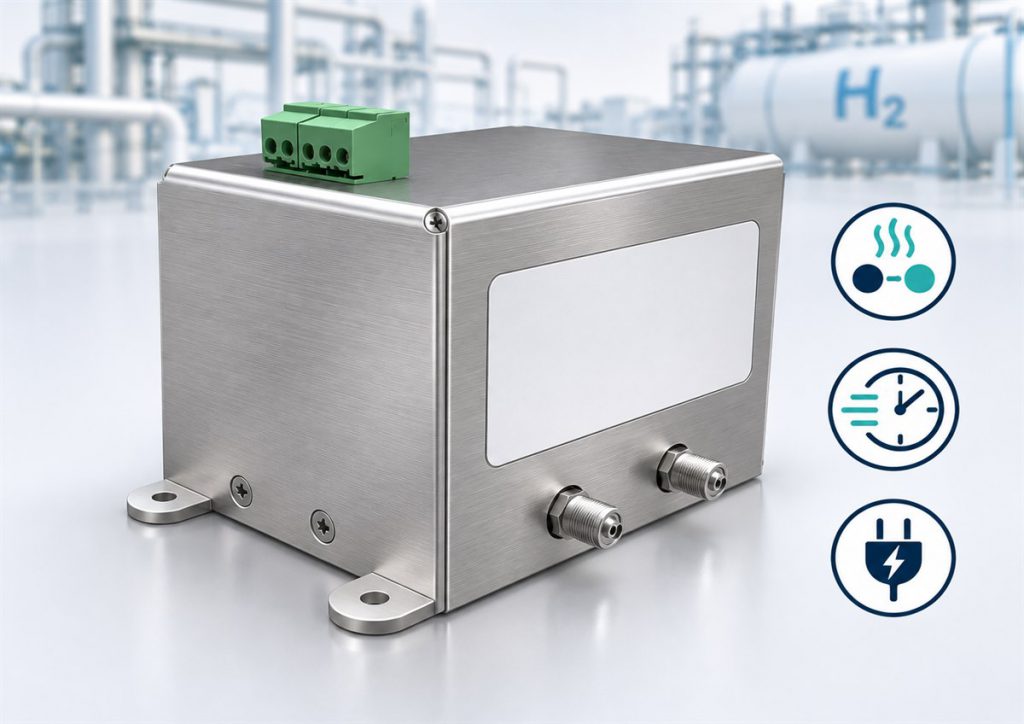
THERMAL CONDUCTIVITY HYDROGEN SENSOR
Reference gas-free•Full-range measurement•Flexible configuration
Measuring range0.2–4% Vol / 0.2–10% Vol
Measurement error±5% F.S.
Repeatability<2%
Response time (T90)<3 s
Supply voltage12 VDC / 24 VDC selectable
Power consumption<1 W
HOW THE PRODUCT WORKS
The TCM101 Thermal Conductivity Hydrogen Purity Sensor is independently designed and developed by the manufacturer. It uses a MEMS-based micro thermal conductivity sensor to measure hydrogen concentration from the thermal conductivity relationship of binary gas mixtures. The diffusion-sampling sensor is intended for hydrogen monitoring in hydrogen generators, hydrogen refueling stations, compressors, energy storage systems and industrial production environments.
The product reference lists two measuring ranges, 0.2–4% Vol and 0.2–10% Vol, with selectable 12 VDC or 24 VDC supply. For a suitable configuration, specify whether your target is hydrogen leak concentration or a purity-related measurement, and share the gas composition, required range and operating conditions with our team. This helps assess a thermal conductivity hydrogen purity sensor for the intended gas mixture and operating environment.
The reference describes hydrogen leak detection from 0 to 10% Vol; selectable measuring ranges are 0.2–4% Vol and 0.2–10% Vol.
The sensor can be installed in narrow equipment spaces where room for monitoring components is limited.
A specified T90 response time below 3 seconds supports timely monitoring of hydrogen concentration changes.
The reference lists a service life of up to 10 years and good long-term stability.
The MEMS thermal conductivity design is presented as reference-gas-free, with range and supply options to confirm for the application.
APPLICATIONS
Monitor hydrogen concentration in generator equipment and related process gas systems.
Integrate hydrogen concentration monitoring into station equipment and process areas.
Support hydrogen monitoring in compressor and storage system designs.
Apply in industrial equipment and production environments where hydrogen concentration must be monitored.
| Parameter | Specification |
|---|---|
| Target gas | Hydrogen (H₂) |
| Detection principle | Thermal conductivity principle (MEMS-based micro sensor) |
| Sampling method | Diffusion type |
| Measuring range | 0.2–4% Vol or 0.2–10% Vol |
| Measurement error | ±5% F.S. |
| Repeatability | <2% |
| Resolution | 0.01% Vol |
| Warm-up time | <10 s |
| Response time (T90) | <3 s |
| Operating voltage | 12 VDC or 24 VDC, selectable |
| Power consumption | <1 W |
Confirm the measuring range, output, power supply, and process conditions for your application when requesting a quotation.
For a project-specific TCM101 Thermal Conductivity Hydrogen Purity Sensor quotation and application review, share your target measurement range, gas composition, operating temperature and humidity, pressure, installation method, required signal output, and project location. This helps our team assess the right configuration for your hydrogen monitoring or gas analysis system.
Send your application detailsFAQ
Find guidance on TCM101 Thermal Conductivity Hydrogen Purity Sensor measuring range, installation, operating conditions, and integration with hydrogen monitoring systems.
The specified options are 0.2–4% Vol and 0.2–10% Vol. The reference also describes hydrogen leak detection up to 10% Vol.
It uses a MEMS-based micro thermal conductivity sensor to measure hydrogen from the thermal conductivity relationship of a binary gas mixture.
The product reference describes the TCM101 as reference-gas-free. Confirm the gas composition and measurement objective for your application.
The reference specifies a warm-up time below 10 seconds and a T90 response time below 3 seconds.
The specified operating voltage is selectable between 12 VDC and 24 VDC.
Please share whether the application concerns hydrogen leak concentration or purity, the gas composition, target range, supply voltage, installation space and operating conditions.
Send your operating conditions and project requirements for a technical review and quotation.
Contact the Sales Team
Hydrogen gas analyzers and leak detectors for purity, concentration, dew point and humidity monitoring. Share your application and operating conditions for product guidance and a quotation.