Natural-diffusion hydrogen sampling
Samples ambient air by natural diffusion for indoor hydrogen leak monitoring.
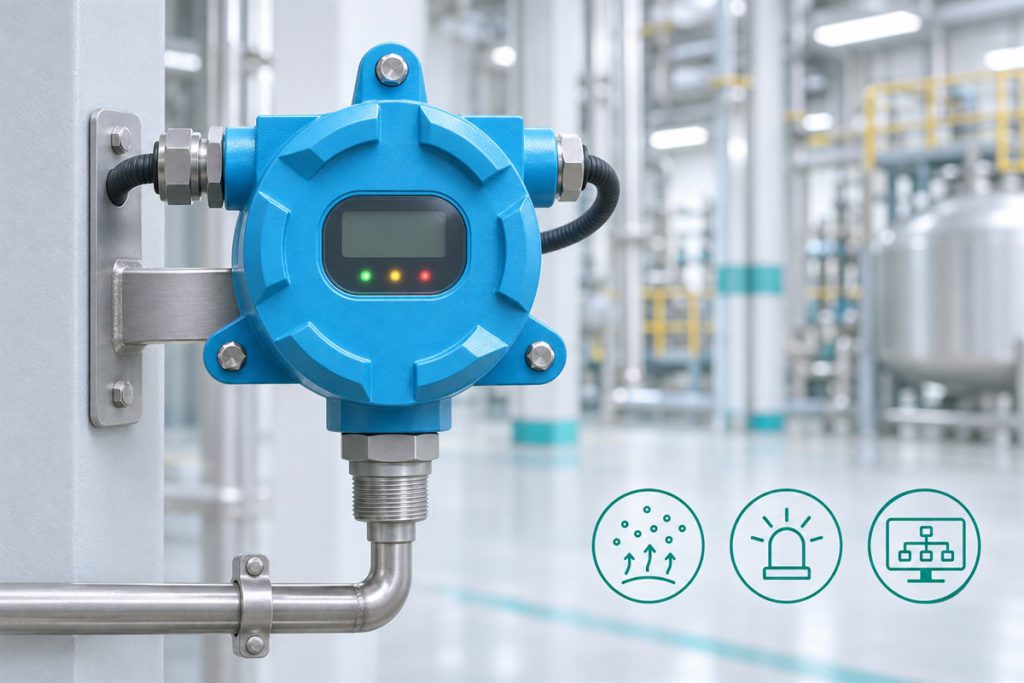
ONLINE HYDROGEN LEAK DETECTOR
Natural-diffusion sampling•Local display•Concurrent 4–20 mA and RS-485•Relay alarms and sensor diagnostics
Measuring range0–100% LEL / 0–4% Vol
Response time (T90)<30 s
Low / high alarm10% LEL / 40% LEL
Concurrent outputs4–20 mA and two-wire RS-485
Relay output1 active alarm relay; 3 A resistive
ProtectionEx d II C T6 Gb; IP65; SIL 2 stated
HOW THE PRODUCT WORKS
The NA1000AW Online Hydrogen Detector monitors hydrogen in ambient air by natural diffusion. It is designed for indoor industrial environments where a hydrogen leak needs to be detected and reported locally and to a central control room. Applications listed in the product documentation include petroleum, chemical, pharmaceutical, iron and steel, and gas storage facilities.
Measured concentration is processed by the transmitter and displayed locally. Concurrent outputs include a 4–20 mA analog signal proportional to the selected 0–100% range, two-wire RS-485 communication, and one active alarm relay output. The relay rating is 3 A for resistive loads at 24 VDC, 120 VAC, or 240 VAC. Confirm controller compatibility, cable routing, alarm logic, and output scaling during system design.
The detector supports wall mounting, with pipe-clamp mounting available as an option. The documented low and high alarm setpoints are 10% LEL and 40% LEL. Field calibration concentration can be adjusted by the user. For centralized bus-powered or independent local-power arrangements, confirm the chosen wiring and 24 VDC supply plan for each channel.
The product documentation describes sensor ageing compensation, sensor-fault identification, over-range protection, power-on self-test, self-diagnosis, and self-recovery. Standard operation is specified from −25 to +60 °C; the catalytic type is specified from −40 to +70 °C. Ambient humidity is below 95% RH, non-condensing. Confirm sensor type, area classification, certification documents, and environmental limits for the actual supplied configuration.
For detector selection or a system quotation, provide the site layout, detection points, expected hydrogen concentration, mounting method, alarm and control-system interfaces, power arrangement, ambient conditions, and required certification. These details help specify a fixed hydrogen detector for indoor industrial leak monitoring.
Samples ambient air by natural diffusion for indoor hydrogen leak monitoring.
Provides 4–20 mA and two-wire RS-485 simultaneously, with an active alarm relay for integration with control-room systems.
Product documentation describes automatic compensation for sensor ageing and identification of sensor faults that could affect detection or alarm capability.
Includes automatic over-range protection, power-on self-test, self-diagnosis, and self-recovery functions.
Supports wall mounting and optional pipe-clamp mounting; documentation lists centralized bus power or independent local power arrangements.
Allows the calibration concentration to be adjusted on site; confirm calibration procedure and target gas requirements with the supplier.
APPLICATIONS
Monitor indoor hydrogen leak points around process equipment and enclosed work areas.
Add hydrogen detection at indoor production, utility, or storage locations where site risk assessment requires it.
Use local readings and remote signals to alert staff and the central control room; determine detector placement through a site survey.
| Parameter | Specification |
|---|---|
| Target gas | Hydrogen (H₂) |
| Sampling method | Natural diffusion |
| Measuring range | 0–100% LEL / 0–4% Vol |
| Repeatability | 2% |
| Span drift | ±5% F.S |
| Zero drift | <2% F.S |
| Response time (T90) | <30 s |
| Low alarm setpoint | 10% LEL |
| High alarm setpoint | 40% LEL |
| Ambient temperature | Standard type: −25 to +60 °C; catalytic type: −40 to +70 °C |
| Ambient humidity | <95% RH, non-condensing |
| Alarm output | One active alarm relay; resistive contact load: 3 A at 24 VDC, 120 VAC, or 240 VAC |
| Communication output | Two-wire RS-485; shielded twisted-pair cable; maximum distance 1000 m |
| Analog output | 4–20 mA proportional to 0–100% range; maximum load 800 Ω; simultaneous with RS-485 |
| Input voltage / power | 24 VDC ±15%; 2 W per channel |
| Explosion-proof marking | Ex d II C T6 Gb (stated in documentation as Exd II CT6 Gb) |
| Ingress protection | IP65 |
| Certification | Explosion-proof certification and SIL 2 certification stated in product documentation; verify supplied certificates |
| Recommended shielded cable | ≥RVVP 4 × 0.75 mm² |
| Cable outer diameter | Ø 6–9 mm |
| Installation | Wall mounting; pipe-clamp mounting optional |
| Dimensions (L × W × H) | 172.5 × 165.5 × 73 mm |
| Weight | About 1 kg |
Confirm the measuring range, output, power supply, and process conditions for your application when requesting a quotation.
For a project-specific NA1000AW Online Hydrogen Detector quotation and application review, share your target measurement range, gas composition, operating temperature and humidity, pressure, installation method, required signal output, and project location. This helps our team assess the right configuration for your hydrogen monitoring or gas analysis system.
Send your application detailsFAQ
Find guidance on NA1000AW Online Hydrogen Detector measuring range, installation, operating conditions, and integration with hydrogen monitoring systems.
It uses natural diffusion to sample ambient air in indoor environments; it is not a pumped sample-draw arrangement according to the supplied documentation.
The documented range is 0–100% LEL / 0–4% Vol. Low and high alarm setpoints are 10% LEL and 40% LEL, respectively.
The product document specifies concurrent 4–20 mA output and two-wire RS-485 communication, together with one active alarm relay. Confirm controller compatibility and output scaling.
Standard operation is specified from −25 to +60 °C; the catalytic type is specified from −40 to +70 °C. Confirm which sensor type and temperature range apply to the offered configuration.
Wall mounting is listed, with pipe-clamp mounting optional. The document lists 24 VDC ±15% input and 2 W per channel and notes centralized bus or independent local power arrangements.
Provide the site and detection-point layout, expected hydrogen range, sensor type, mounting preference, alarm logic, RS-485 or 4–20 mA interfaces, power plan, ambient conditions, and required certificates.
Send your operating conditions and project requirements for a technical review and quotation.
Contact the Sales Team
Hydrogen gas analyzers and leak detectors for purity, concentration, dew point and humidity monitoring. Share your application and operating conditions for product guidance and a quotation.