Expandable 1–16 detector channels
Modular controller design accepts 1–16 compatible detectors using three-wire 4–20 mA input or RS-485 bus communication.
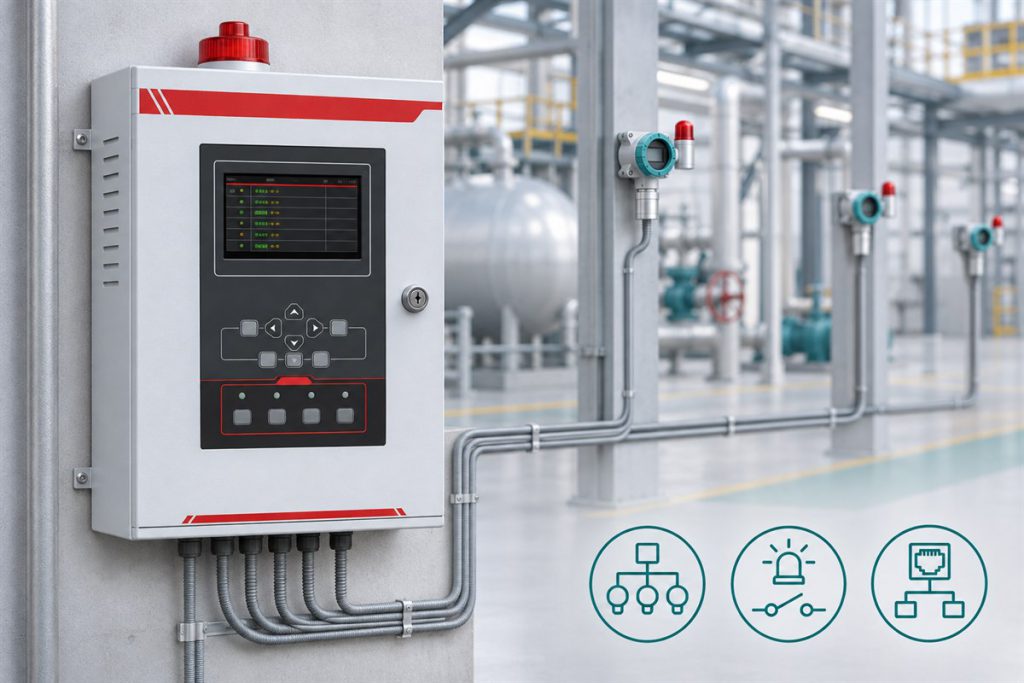
1–16 CHANNEL GAS DETECTION ALARM CONTROLLER
1–16 detector channels•4–20 mA and RS-485 inputs•Audible/visual alarms•Ethernet and relay outputs
Supported channels1–16 compatible detectors
Signal inputsThree-wire 4–20 mA and RS-485 bus detectors
Alarm modesLow, high, and fault alarms
Signal outputsSwitch value, RS-485, Ethernet
Relay outputs2 dry normally-open groups; 10 A at 250 VAC
Main power85–265 VAC, 50/60 Hz
HOW THE PRODUCT WORKS
The RD3000E Gas Leakage Detection Alarm Controller centralizes signals from compatible gas detectors across industrial sites. It supports 1–16 detection channels, accepting three-wire 4–20 mA detectors and RS-485 bus-type detectors, and can upload RS-485 communication data to host software. Depending on the selected detectors, the system can monitor combustible gases, toxic and harmful gases, temperature, and humidity.
A large LCD displays live concentration readings, and users can adjust high and low alarm setpoints. The controller provides low alarm, high alarm, and fault alarm modes. When a configured reading reaches its alarm condition, the controller issues audible and visual alarms and can drive exhaust ventilation or other connected equipment through relay outputs. Detector selection and setpoints must be matched to the target gas and site requirements.
The RD3000E accepts three-wire 4–20 mA analog inputs and RS-485 bus-type detectors. Its listed outputs include switch signals, RS-485, and Ethernet. Two groups of dry normally-open relay contacts are specified, rated 10 A at 250 VAC. Confirm compatible detector models, communication protocol, channel allocation, relay loads, and host software interface before system integration.
The controller automatically stores at least 10,000 alarm records and uses two-level password management. Main supply is 85–265 VAC, 50/60 Hz; an optional backup supply uses two rechargeable 12 V / 7.2 Ah lead-acid batteries. The wall-mounted enclosure measures 500 × 360 × 122 mm and weighs about 15 kg. Verify environmental limits, mounting clearances, cable routes, and certification documents for the supplied configuration.
For a system quotation, provide the site type, target gases, detector models and quantity, 4–20 mA or RS-485 interfaces, alarm setpoints, relay-driven equipment, Ethernet or host software needs, backup power requirement, and installation environment. This helps match the multi-channel gas detection alarm controller to compatible detector signals and site alarm requirements.
Modular controller design accepts 1–16 compatible detectors using three-wire 4–20 mA input or RS-485 bus communication.
The large LCD displays live concentration values; high and low alarm setpoints can be adjusted for compatible detector and target gas configurations.
Low, high, and fault conditions can trigger audible and visual alarms. Two normally-open dry contact groups are provided for configured external equipment.
The controller supports RS-485 and Ethernet outputs, including upload of RS-485 detector communication data to host software; confirm protocol and software compatibility.
Automatically stores at least 10,000 alarm records and provides two-level password management.
Main power operates from 85–265 VAC; an optional backup arrangement uses two 12 V / 7.2 Ah rechargeable lead-acid batteries.
APPLICATIONS
Centralize compatible gas detector signals and alarms across hydrogen station or production facility detection points.
Monitor configured combustible and toxic gas detection points and route alarms to ventilation or other equipment.
Connect multiple detectors for centralized readings and low/high alarm handling, subject to site design and detector compatibility.
Use multi-channel alarm control where industrial risk assessment calls for gas leak monitoring and control-room reporting.
| Parameter | Specification |
|---|---|
| Model | RD3000E |
| Supported detector channels | 1–16 channels |
| Signal input | Three-wire 4–20 mA analog detectors and RS-485 bus-type detectors |
| Maximum permissible error | ±5% F.S |
| Alarm modes | Low alarm, high alarm, fault alarm |
| Signal outputs | Switch value, RS-485 bus, Ethernet |
| Relay output | 2 groups of dry normally-open contacts; 10 A at 250 VAC |
| Display and alarm settings | Large LCD; live concentration display; adjustable high and low alarm setpoints |
| Alarm record storage | At least 10,000 records |
| Access control | Two-level password management |
| Main power supply | 85–265 VAC, 50/60 Hz |
| Optional backup power | 2 × 12 V / 7.2 Ah rechargeable lead-acid batteries |
| Power consumption | 45 W, excluding detectors |
| Operating temperature | −10 to +55 °C |
| Operating humidity | ≤95% RH; confirm condensation conditions for supplied configuration |
| Mounting | Wall-mounted |
| Dimensions (L × W × H) | 500 × 360 × 122 mm |
| Weight | About 15 kg |
| Certifications stated in product documentation | Explosion-proof, CCCF fire certification, and CE; verify certificates applicable to the supplied configuration |
Confirm the measuring range, output, power supply, and process conditions for your application when requesting a quotation.
For a project-specific RD3000E Gas Leakage Detection Alarm Controller quotation and application review, share your target measurement range, gas composition, operating temperature and humidity, pressure, installation method, required signal output, and project location. This helps our team assess the right configuration for your hydrogen monitoring or gas analysis system.
Send your application detailsFAQ
Find guidance on RD3000E Gas Leakage Detection Alarm Controller measuring range, installation, operating conditions, and integration with hydrogen monitoring systems.
The published configuration supports 1–16 detector channels. Confirm the number and type of input modules required for the project.
The controller accepts three-wire 4–20 mA analog detectors and RS-485 bus-type detectors. Confirm the supported detector models and communication protocol.
The listed alarm modes are low, high, and fault alarms. Outputs include switch value, RS-485, Ethernet, and two groups of dry normally-open relay contacts rated 10 A at 250 VAC.
The product documentation states that alarm outputs can drive exhaust ventilation and other equipment. Verify the connected load, relay arrangement, and safety interlocks with the system designer.
An optional backup supply is specified as two rechargeable 12 V / 7.2 Ah lead-acid batteries. Confirm backup runtime and configuration with the supplier.
Share target gases, detector models and quantity, channel signals, alarm setpoints, relay loads, host software and Ethernet needs, backup supply, site environment, and required certification documents.
Send your operating conditions and project requirements for a technical review and quotation.
Contact the Sales Team
Hydrogen gas analyzers and leak detectors for purity, concentration, dew point and humidity monitoring. Share your application and operating conditions for product guidance and a quotation.