Configure online gas analysis around your hydrogen production process, target gas components, sample conditions and data interface requirements. Share the process information available for an analyzer review. The measurement scope and sampling arrangement should be selected for the specific process stream and the verified capabilities of the chosen analyzer.
Online gas analysis for hydrogen production
Hydrogen production processes may require gas composition measurements at selected process points. Depending on the process and analyzer configuration, online analysis can provide measurement data for process monitoring, product checks or equipment evaluation. The measurement objective, target components and sampling locations should be defined before equipment selection.
Different production routes, gas compositions and sample conditions may require different configurations. Confirm the applicable process and measurement needs; do not assume that one analyzer configuration covers every production process.
Define target components and measurement range
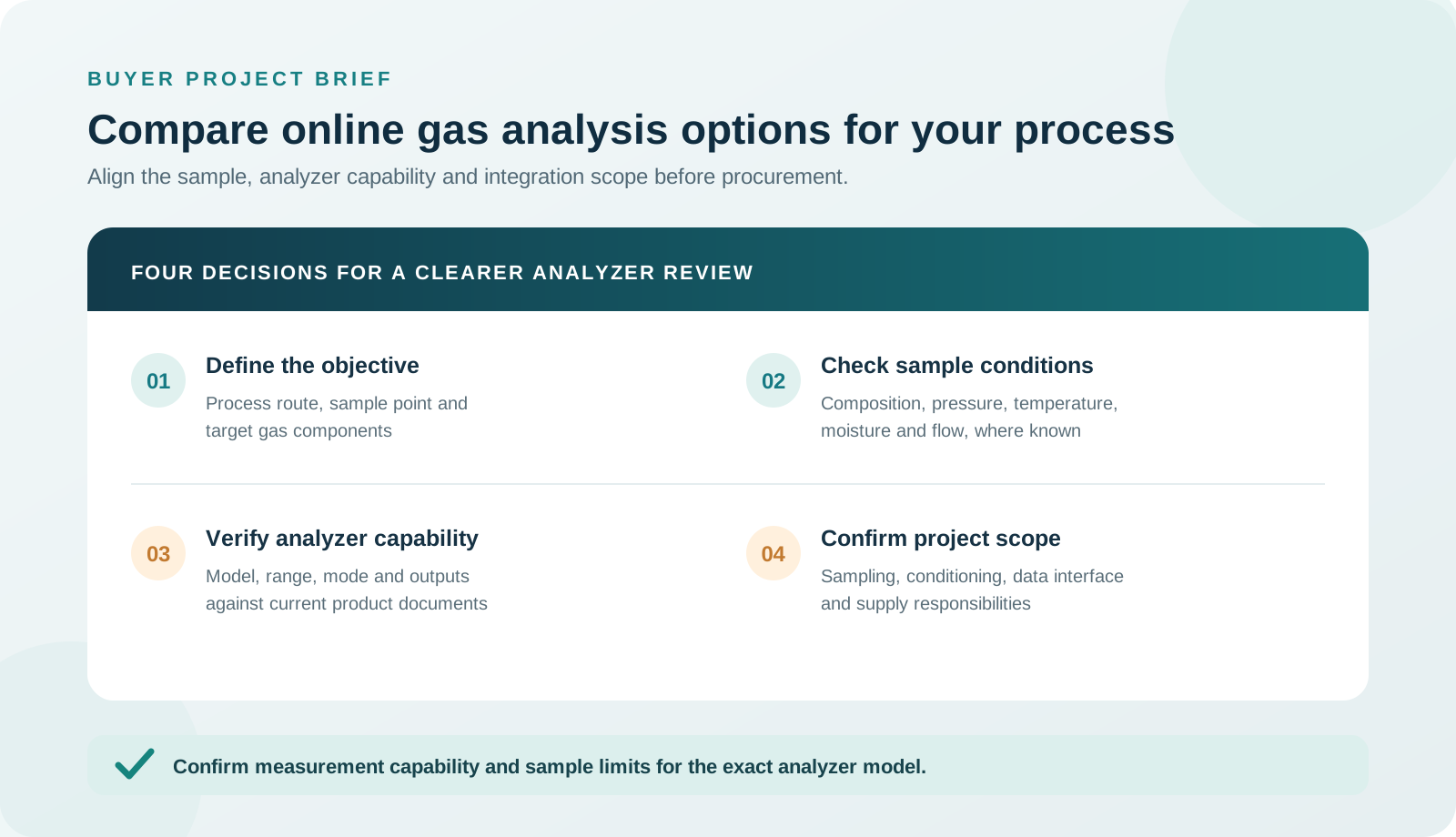
Start with the components that need to be measured and the purpose of each measurement. For every candidate analyzer, review its published target components, model-specific range and units, measurement principle, measurement mode, sample-condition limits and outputs. Use the current product datasheet for specifications; do not infer performance from a general product category.
- Target components: list the gas components required for the process objective and verify that the selected model supports them.
- Measurement range: define the expected range and units using process data and the model documentation.
- Measurement mode: confirm whether the proposed analyzer performs continuous online measurement or uses another sampling mode.
- Sample conditions: provide pressure, temperature, moisture, flow and any other relevant sample information for compatibility review.
- Outputs: confirm available analog, digital, communication or alarm outputs for the selected model.
From process sample to analyzer output
A project may route a process sample to a gas analyzer, with sample line or conditioning equipment added only when required by the stream and the analyzer limits. The analyzer then provides measurement data through its supported output. The exact configuration depends on sample composition, pressure, temperature, moisture, flow and installation conditions.
ILLUSTRATIVE SAMPLE AND DATA FLOW
Analyzer and sampling system components
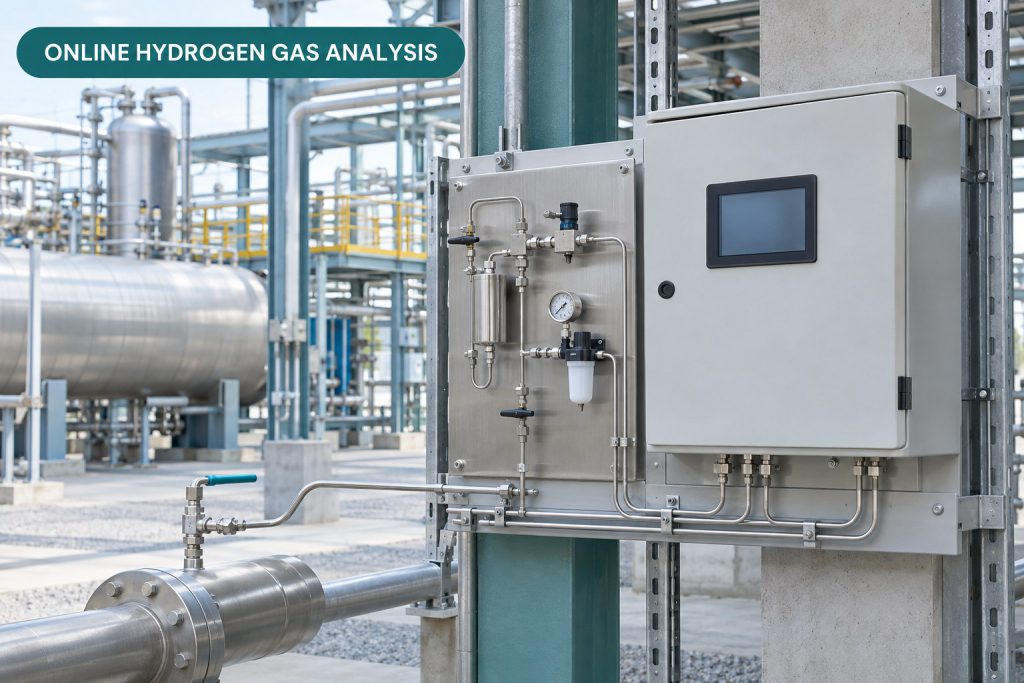
Depending on the application, a configured system may include an online gas analyzer, sampling probe and line, sample conditioning components, flow or pressure controls, display, controller, data interface and installation accessories. Distinguish standard supply, optional equipment and project-specific items before procurement.
- PDM400 Online Hydrogen Analyzer — review current product information for model-specific measurement capabilities and operating conditions.
- RD330 Online Hydrogen Analyzer — verify the published analyzer specifications and outputs for the intended measurement point.
These product links are starting points for evaluation, not a claim that either model is suitable for every process stream. Confirm target components, measurement range, sample limits, measurement principle and interface options from the applicable datasheet.
Analyzer selection starts with process conditions
Analyzer selection depends on the process stream, target components, measurement range, sample pressure and temperature, moisture level, flow, installation environment and required data interface. Review the sample conditions against the limits of the selected model before finalizing the analyzer and sampling arrangement.
For an initial review, provide the process route, measurement objective, process flow diagram if available, sample point, gas composition, operating conditions and required output interface. Process drawings or gas data sheets can be shared as optional supporting information.
Data output and plant integration
Available outputs and communication options depend on the analyzer model. Integration with a PLC, DCS, SCADA or data historian requires confirmation of the analyzer interface, protocol, update needs, alarm handling and plant design. Do not assume the analyzer automatically optimizes or controls the hydrogen production process unless a separately verified control system is within the project scope.
From process review to analyzer configuration
- Share the production route, measurement objective and available process data.
- Confirm target components, sample conditions and required measurement range.
- Review the analyzer model and any sampling or conditioning requirements.
- Confirm data outputs, integration boundaries and the agreed project support scope.
- Finalize the technical configuration and supply scope against current product documentation.
Discuss your hydrogen production analysis requirements with our team. Share the information available; a complete process package is not required to begin a discussion.
Online hydrogen production gas analysis FAQs
Which gas components can an analyzer measure?
Supported components vary by model. Confirm the component list, applicable range and sample conditions in the current datasheet for the selected analyzer.
Is the analyzer designed for continuous online measurement?
Measurement mode depends on the offered model. Verify whether it measures continuously or uses periodic sampling before specifying it for a process point.
Does the process sample require conditioning?
That depends on sample composition, pressure, temperature, moisture, flow and analyzer limits. Review the process conditions before confirming any sample-conditioning equipment.
Can the analyzer connect to a plant PLC or SCADA system?
Connection depends on the selected model’s available outputs and the plant interface requirements. Confirm the protocol, connection conditions and project responsibilities during review.