
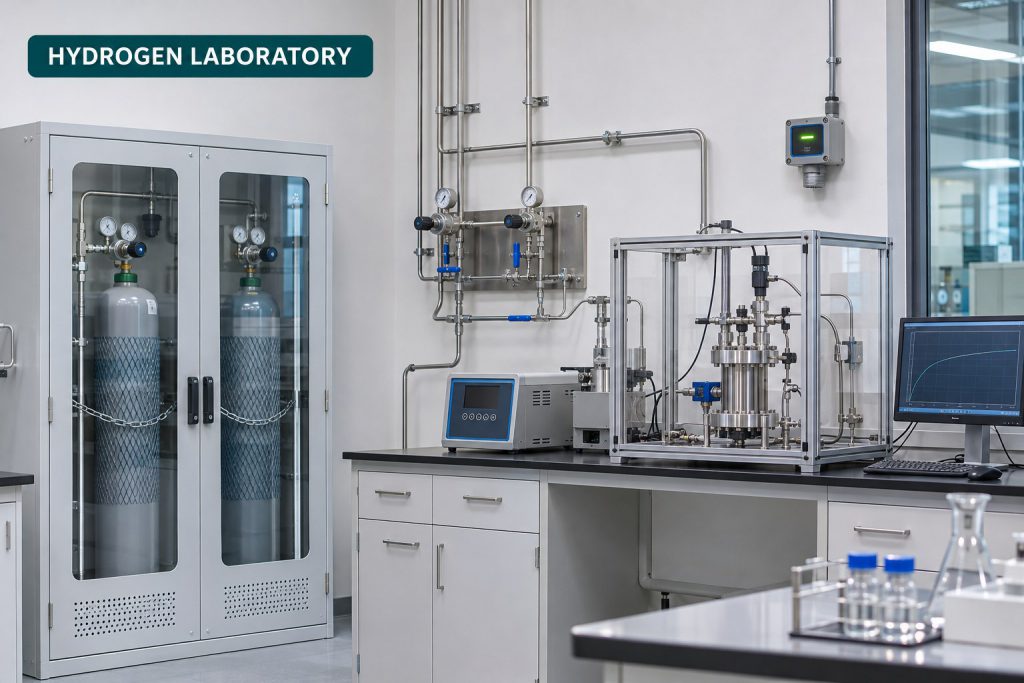
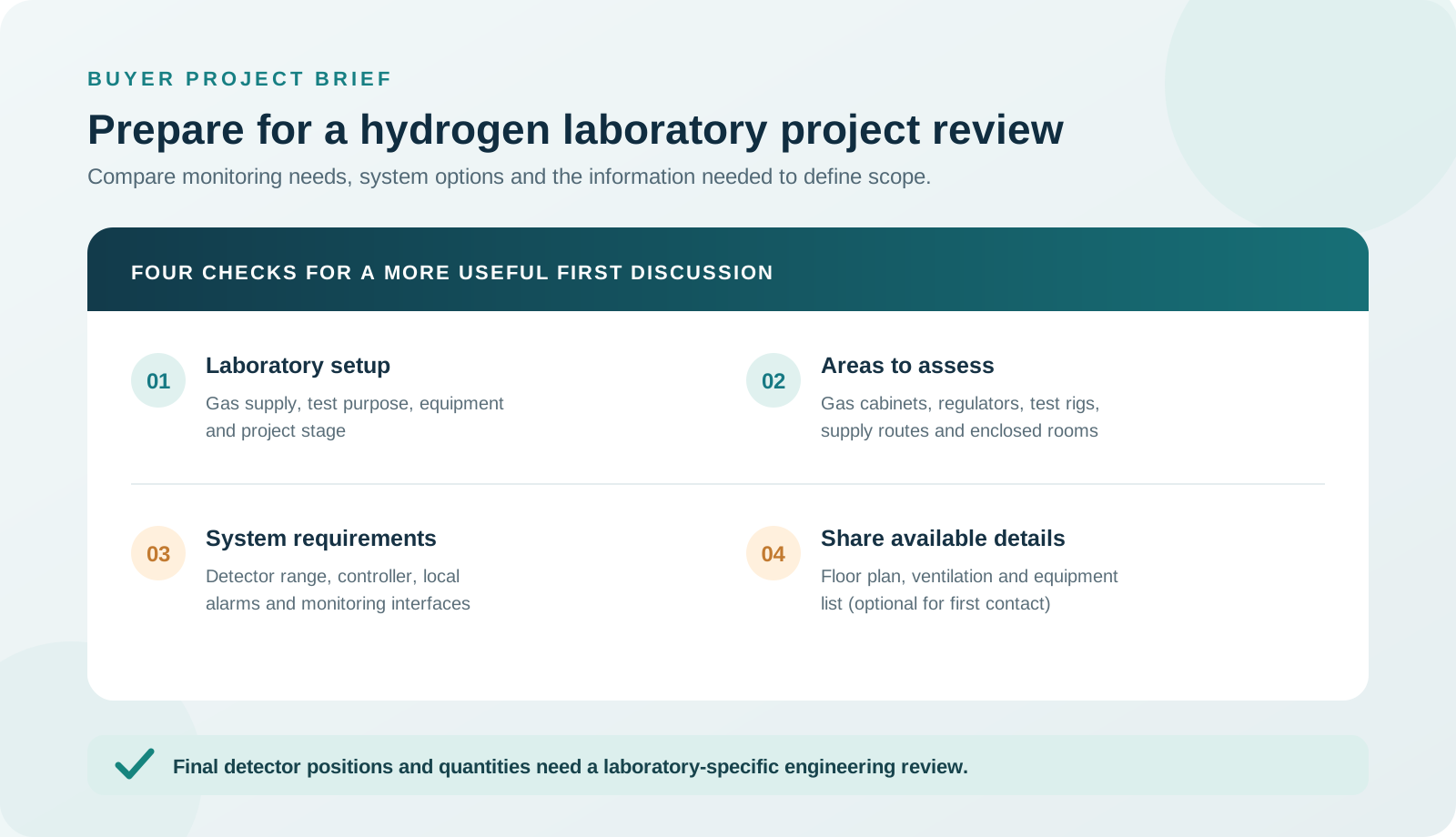
Plan hydrogen leak detection around your laboratory’s gas supply points, equipment layout, ventilation and alarm requirements. This safety monitoring solution for hydrogen-related laboratories is intended to support a project review of selected monitoring areas, detector and controller options, and alarm interfaces. The suitable configuration depends on the facility, the gas supply arrangement and the laboratory’s wider safety design.
Hydrogen leak detection for laboratories
Hydrogen laboratories may use gas for research, testing, calibration or equipment operation. A fixed hydrogen gas detection system can monitor selected locations and send alarm signals to personnel or connected systems, subject to the selected equipment and project interfaces. The monitoring plan should reflect the laboratory process, room layout, ventilation and applicable safety requirements.
Depending on the actual project scope, applications may include research laboratories, fuel cell test areas or hydrogen sensor calibration facilities. Confirm the intended application and operating conditions before selecting a detector. Gas detection is one element of a broader laboratory safety design; it does not replace ventilation, operating procedures, other safeguards or a responsible site risk assessment.
Areas to consider in a laboratory review
Use the following as starting points for assessment, where applicable to the laboratory:
- Cylinder storage, gas cabinets and hydrogen supply connections.
- Hydrogen piping, valves, fittings and pressure regulators.
- Laboratory benches, test equipment and experimental apparatus using hydrogen.
- Hydrogen generators, purification equipment or compressors, where present.
- Ventilation cabinets, equipment rooms and locations with restricted air movement.
- Gas delivery routes between storage and laboratory equipment.
Final detector locations and quantities depend on likely release points, room airflow, ventilation, equipment arrangement, room geometry, maintenance access and applicable requirements. A generic list or diagram cannot replace a project-specific assessment.
How a hydrogen detection system works
A project concept may connect a hydrogen detector to a compatible gas detection controller, which processes and indicates alarm status. Depending on confirmed equipment and project requirements, the controller may provide outputs to a local audible or visual alarm or an approved monitoring interface. Any connection to a building management system, PLC, exhaust control or shutoff interlock needs a separate compatibility and responsibility review.
ILLUSTRATIVE SYSTEM FLOW
System components and configuration
A laboratory monitoring configuration may include fixed hydrogen detectors, a gas detection controller, local audible or visual alarms, monitoring interfaces and accessories. Review each item against the laboratory requirements:
- Hydrogen detector: verify the model, measurement range, signal output, operating environment and applicable approvals against current documentation.
- Gas detection controller: check channel count, display, alarm outputs and confirmed communication interfaces.
- Alarm and monitoring interfaces: confirm the equipment, connection conditions, supported protocols and integration boundaries.
- Accessories and support: confirm available mounting parts, enclosures, sampling components, technical assistance or commissioning scope.
For product information, review the NA1000AW Online Hydrogen Detector and the RD3000E Gas Leakage Detection Alarm Controller. These are examples from the site catalog; confirm model specifications and compatibility for the proposed laboratory configuration before procurement.
Detector placement starts with the laboratory layout
Detector placement should account for likely release points, gas flow, ventilation, room geometry, equipment locations and maintenance access. The final plan should also follow project engineering and applicable local requirements. Avoid using a generic drawing as a fixed placement recommendation.
For an initial review, share a floor plan if available, gas supply details, an equipment list, ventilation information, required alarm behavior and any monitoring interface requirements. Drawing and equipment-list uploads can remain optional at first contact.
Send your laboratory project details to discuss the monitoring scope and next steps.
From project review to system configuration
- Tell us the laboratory type, location and project stage.
- Share available floor plans, gas supply details and equipment information.
- Review candidate monitoring areas, detector options and alarm interfaces.
- Confirm the proposed scope, documentation and support arrangements.
Installation guidance, commissioning, remote assistance or on-site services should be confirmed as part of the actual project scope.
Hydrogen laboratory leak detection FAQs
Where should hydrogen detectors be installed in a laboratory?
Locations depend on likely release points, room airflow, ventilation, equipment arrangement and applicable requirements. A project review should confirm the final positions and quantities.
Can the system connect to a laboratory alarm or monitoring system?
That depends on the selected controller, its available outputs and the laboratory system. Share the required interface for a compatibility review.
What information is needed for a project quotation?
A floor plan, gas supply details, equipment list, project location and required alarm interfaces help define the project scope. Share the information available; a complete drawing package is not required to start a discussion.
Does gas detection replace ventilation or other safety measures?
No. Gas detection is one element of a broader laboratory safety design. Ventilation, operating procedures and other safeguards should be addressed by the responsible project team.