Centralized monitoring at up to 16 points
Connect multiple NA1000DII transmitters to an NA1000MR controller to display hydrogen concentration and alarm status at a central location.
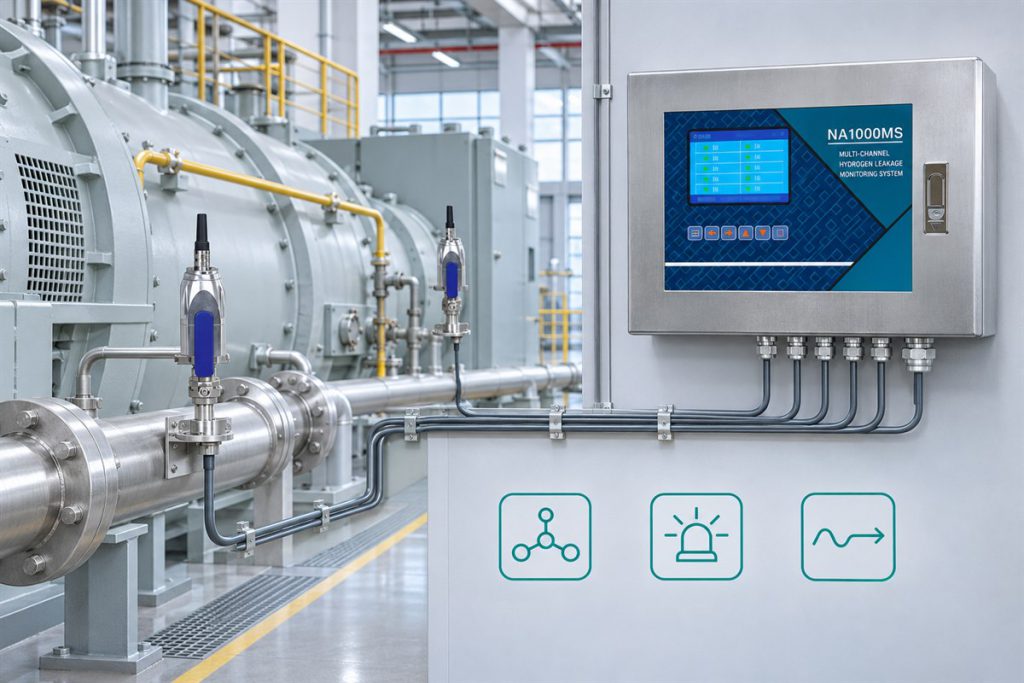
MULTI-CHANNEL HYDROGEN LEAK MONITORING SYSTEM
NA1000MR controller + NA1000DII transmitters•Up to 16 detection points•Branch and master alarms•Centralized concentration display
System configurationNA1000MR controller + NA1000DII transmitters
Maximum transmitter countUp to 16
Transmitter range0–4% Vol / 0–100% LEL
Transmitter accuracy±2% F.S
Controller outputs4–20 mA per channel; branch and master alarms
Transmitter protectionEx ia IIC T4 Ga
HOW THE PRODUCT WORKS
The NA1000MS Multi-channel H₂ Leakage Monitoring System combines an NA1000MR multi-channel alarm controller with NA1000DII hydrogen monitoring transmitters. It is designed to monitor hydrogen concentration at multiple points on hydrogen-cooled generator sets and display channel readings and alarm status at a central controller. The system supports up to 16 transmitters for distributed detection and centralized supervision.
A TFT color LCD displays hydrogen concentration and alarm conditions from connected channels. The controller accepts two-wire 4–20 mA transmitters, with 1–8 channels as the base input configuration and support for up to 16 channels. Separate branch alarms and a master alarm can help operators identify which detection point needs attention. Alarm history storage is specified for up to 8,000 records.
The product information describes dedicated sampling arrangements for generator busbar neutral points, steam-exciter end oil return systems, and internal cooling-water tanks. NA1000DII transmitters use natural diffusion and a full-metal explosion-proof enclosure, with an Ex ia IIC T4 Ga marking. The transmitter is stated to be replaceable by its core component during maintenance. Confirm the sample point, enclosure installation, cable route, and maintenance access for each location.
The controller can provide 4–20 mA outputs for connected channels and normally-open relay outputs for individual branch alarms and a master alarm. The listed controller supply is 210–230 VAC, 50/60 Hz; the transmitter uses 24 VDC at less than 1 W. Confirm the number of channels, output mapping, alarm logic, cable specification, and power arrangement before ordering.
For a system quotation, share the generator type, number and location of detection points, required measuring range, alarm and control-room interfaces, cable distances, power availability, hazardous-area classification, and preferred mounting arrangement. This information helps configure a multi-channel hydrogen leak monitoring system for generator installations.
Connect multiple NA1000DII transmitters to an NA1000MR controller to display hydrogen concentration and alarm status at a central location.
The controller supports individual branch alarms and a master alarm, with normally-open relay contacts and stored alarm history.
Controller outputs provide 4–20 mA signals for connected channels; confirm channel count and output mapping for the project.
The product information describes arrangements for busbar neutral points, oil return systems, and internal cooling-water tanks. Final probe placement should follow a site survey.
NA1000DII uses a full-metal explosion-proof enclosure and is listed as Ex ia IIC T4 Ga. Verify applicable certificates and hazardous-area classification.
The manufacturer states that maintenance can be performed by replacing the transmitter core component; confirm spare part and service procedure availability.
APPLICATIONS
Monitor hydrogen at generator busbar neutral points and other project-defined leak detection locations.
Use dedicated sampling arrangements at steam-exciter end oil return systems and internal cooling-water tanks where applicable.
Display readings and alarm status centrally, and transmit channel signals to plant monitoring systems through the configured 4–20 mA and relay interfaces.
| Parameter | Specification |
|---|---|
| System components | NA1000MR multi-channel alarm controller and NA1000DII hydrogen monitoring transmitters |
| Maximum number of transmitters | Up to 16 for multi-point centralized monitoring |
| NA1000MR display | TFT 256-color LCD |
| NA1000MR input | 1–8 channels of two-wire 4–20 mA transmitters; up to 16 channels |
| NA1000MR supply / power consumption | 24 V; ≤0.48 W (as listed in source specification) |
| NA1000MR connection | Two-core shielded cable |
| NA1000MR analog output | 1–8 channels of 4–20 mA output; up to 16 channels |
| NA1000MR output impedance | <750 Ω |
| NA1000MR relay contact mode | Normally open |
| NA1000MR alarm outputs | 1–16 branch alarms and 1 master alarm |
| NA1000MR alarm contact rating | 1 A at 30 VDC or 1 A at 250 VAC |
| NA1000MR alarm history | 8,000 alarm records |
| NA1000MR working voltage | 210–230 VAC, 50/60 Hz |
| NA1000MR installation | Wall-mounted |
| NA1000MR dimensions (L × W × H) | 440 × 330 × 130 mm |
| NA1000MR weight | 9.5 kg |
| NA1000DII target gas | Hydrogen (H₂) |
| NA1000DII measuring range | 0–4% Vol / 0–100% LEL |
| NA1000DII accuracy | ±2% F.S |
| NA1000DII sampling method | Natural diffusion |
| NA1000DII ambient temperature | −10 to +50 °C |
| NA1000DII ambient humidity | 0–98% RH |
| NA1000DII explosion-proof marking | Ex ia IIC T4 Ga |
| NA1000DII supply / power | 24 VDC; <1 W |
Confirm the measuring range, output, power supply, and process conditions for your application when requesting a quotation.
For a project-specific Multi-channel H2 Leakage Monitoring System quotation and application review, share your target measurement range, gas composition, operating temperature and humidity, pressure, installation method, required signal output, and project location. This helps our team assess the right configuration for your hydrogen monitoring or gas analysis system.
Send your application detailsFAQ
Find guidance on Multi-channel H2 Leakage Monitoring System measuring range, installation, operating conditions, and integration with hydrogen monitoring systems.
The published configuration consists of an NA1000MR multi-channel alarm controller and NA1000DII hydrogen monitoring transmitters.
The system is specified to support up to 16 transmitters. The controller input and output channel configuration should be confirmed for the required system build.
The controller supports 4–20 mA channel outputs and normally-open branch and master alarm relay outputs. Confirm exact channel mapping and alarm contact requirements.
The product page lists 0–4% Vol / 0–100% LEL with ±2% F.S accuracy and natural-diffusion sampling.
The manufacturer describes dedicated arrangements for generator busbar neutral points, oil return systems, and internal cooling-water tanks. A site survey is needed to define the final locations and wiring.
Provide the generator type, number and location of detection points, required range, alarm logic, output interfaces, cable distances, power supply, area classification, and mounting requirements.
Send your operating conditions and project requirements for a technical review and quotation.
Contact the Sales Team
Hydrogen gas analyzers and leak detectors for purity, concentration, dew point and humidity monitoring. Share your application and operating conditions for product guidance and a quotation.