Self-powered fuel-cell sensing
The micro fuel-cell principle generates a current signal without an external power supply.
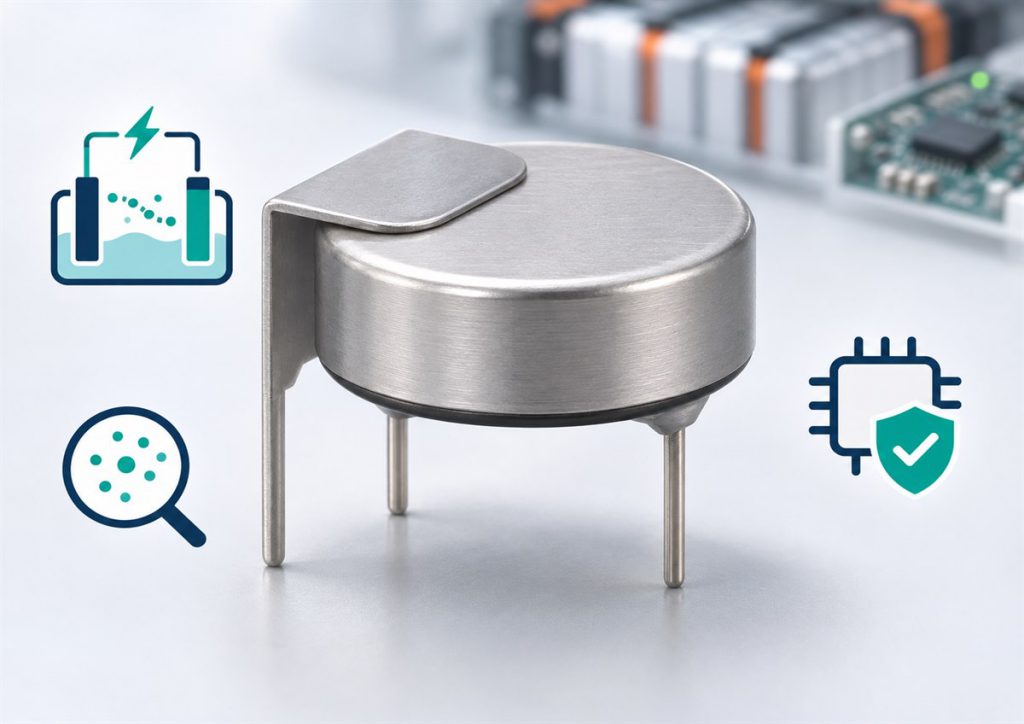
FUEL-CELL HYDROGEN SENSOR
Micro fuel-cell principle•Self-powered operation•Linear output•1 ppm detection limit
Measuring range0–1000 ppm
Accuracy±3% F.S.
Lower detection limit1 ppm
Response time (T90)<60 s
Repeatability3%
Service life6 years (normal operation)
HOW THE PRODUCT WORKS
The FC-H2 Fuel Cell Hydrogen Sensor (model FC-H₂-1000) measures hydrogen concentration using a micro fuel-cell sensing principle. Hydrogen reaches the sensing element by natural diffusion. Oxidation at the positive electrode and oxygen reduction at the negative electrode create an electrochemical current proportional to hydrogen concentration, enabling quantitative measurement.
The sensor operates without an external power supply and is specified for a 0–1000 ppm measuring range, a 1 ppm lower detection limit and ±3% F.S. accuracy. It is intended for lithium-battery and energy-storage safety monitoring, residential and commercial water-gas alarms, industrial safety environments and fire-protection systems.
The cylindrical sensor body is specified at Ø13 ±0.2 mm, with a 6 mm body height and 11 mm overall height including pins. The pin spacings are 7.5 mm and 8.3 mm; pin width is 0.8 mm and pin thickness is 0.2 mm. The drawing also marks 12 ±0.3 mm, 6.8 ±0.3 mm, 5.4 mm and 1 mm mounting/lead dimensions. Confirm the dimension locations against the outline drawing before designing a PCB or enclosure. This dimensional check is useful when integrating a fuel cell hydrogen sensor into a battery safety alarm or hydrogen leak detection device.
The micro fuel-cell principle generates a current signal without an external power supply.
The specified lower detection limit is 1 ppm across a 0–1000 ppm measuring range.
The sensor response is specified below 60 seconds, with output current proportional to hydrogen concentration.
The product documentation lists no silicone poisoning.
The stated service life is 6 years under normal operating conditions, with a 12-month warranty.
APPLICATIONS
Monitor hydrogen as part of battery equipment and safety system design.
Integrate hydrogen monitoring into energy-storage station safety systems.
Use in alarm equipment designed for residential or commercial gas safety monitoring.
Monitor hydrogen in industrial safety applications and equipment.
Include hydrogen sensing in fire-protection and related safety systems.
| Parameter | Specification |
|---|---|
| Model | FC-H₂-1000 |
| Target gas | Hydrogen (H₂) |
| Detection principle | Micro fuel cell |
| Measuring range | 0–1000 ppm |
| Maximum overload | 2000 ppm |
| Sensitivity | 0.4 ± 0.2 nA/ppm |
| Response time (T90) | <60 s |
| Accuracy | ±3% F.S. |
| Lower detection limit | 1 ppm |
| Repeatability | 3% |
| Output linearity | Linear |
| Operating temperature | −40 to +70 °C |
| Operating pressure | Standard atmospheric pressure ±10% |
| Operating humidity | 10–90% (non-condensing) |
| Service life | 6 years (normal operating conditions) |
| Warranty | 12 months |
| Weight | 3 g |
| Silicone poisoning | None |
Confirm the measuring range, output, power supply, and process conditions for your application when requesting a quotation.
For a project-specific FC-H2 Fuel Cell Hydrogen Sensor quotation and application review, share your target measurement range, gas composition, operating temperature and humidity, pressure, installation method, required signal output, and project location. This helps our team assess the right configuration for your hydrogen monitoring or gas analysis system.
Send your application detailsFAQ
Find guidance on FC-H2 Fuel Cell Hydrogen Sensor measuring range, installation, operating conditions, and integration with hydrogen monitoring systems.
The specified range is 0–1000 ppm, with a lower detection limit of 1 ppm and a maximum overload of 2000 ppm.
Hydrogen reaches a micro fuel-cell sensing element by natural diffusion. The electrochemical current produced is proportional to hydrogen concentration.
The product documentation describes signal generation without an external power supply, based on the micro fuel-cell principle.
The specified operating temperature is −40 to +70 °C, operating pressure is standard atmospheric pressure ±10%, and humidity is 10–90% non-condensing.
Share your target concentration range, gas environment, temperature, pressure and humidity conditions, installation dimensions, application and quantity so the configuration can be reviewed.
Send your operating conditions and project requirements for a technical review and quotation.
Contact the Sales Team
Hydrogen gas analyzers and leak detectors for purity, concentration, dew point and humidity monitoring. Share your application and operating conditions for product guidance and a quotation.